

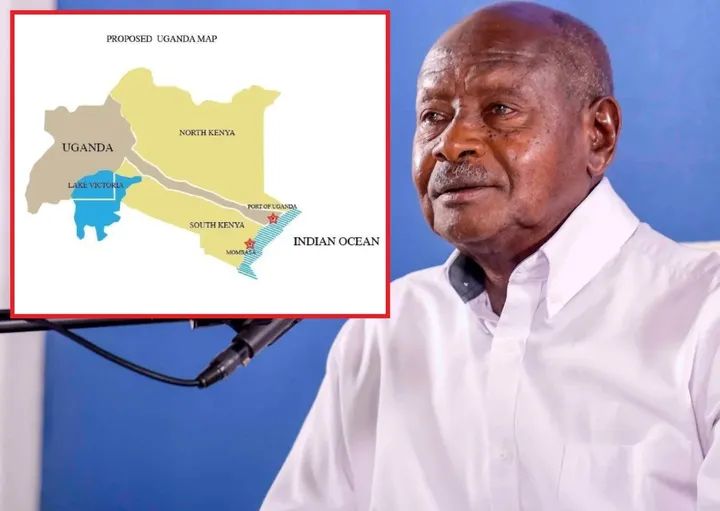
Recent comments by the President of Uganda regarding the Indian Ocean have once again underscored the long-standing Pan-African vision of a United States of Africa—one in which the resources of the Indian Ocean are shared equitably among all African nations. His remarks highlight a core principle of true continental integration: no African country should remain landlocked or deprived of access to strategic natural resources simply because of colonial-era borders.
To illustrate the imbalance, Madagascar alone has a coastline of approximately 4,828 km, the longest in Africa. Somalia, on the other hand, holds the longest mainland coastline on the continent, stretching over 3,300 km along the Indian Ocean and the Gulf of Aden. Combined, Madagascar and Somalia possess a staggering 8,128 km of coastline—an expanse large enough to be subdivided and shared among all 16 African states that are currently landlocked.
Some African countries hold more coastline than they can meaningfully utilize, while others suffer from economic, strategic, and developmental disadvantages simply because they lack direct access to the sea. A continental approach to coastline access—rooted in unity and collective progress—would add far greater value to Africa as a whole.
Such fairness and shared prosperity can only be realized through a true Pan-African renaissance, where unity overrides fragmentation and the resources of Africa, including its vast coastlines, benefit every African nation equally.
Africa must unite and rise above individualism.
